Italian - ItalyEnglish (United Kingdom)

History of Politeama Garibaldi

PDFPrintE-mail

Teatro PoliteamaIn 1859, even though the city of Palermo was well furnished with public theatres, the idea of creating an international competition for the construction of a new theatre named for Ferdinand II gained momentum. The theatre was to be built in Piazza Marina. The City Government of Palermo deemed the building of a theatre an absolute necessity. It was to be an work of great importance and value for the city, to be built utilizing a great number of local artists and artisans. In 1860, however, after the arrival of Garibaldi's Thousand and the fall of domination by the Bourbons, the idea of building a new theatre seemed to wane and four more years would pass before the project would begin. In 1864, in fact, thanks to the vision of Mayor Antonio Starabba, the Marquis of Rudinì, the city administration launched an international competition for the construction of a monumental opera theatre (which would later become the Massimo Theatre) and, in 1865, a local competition for the construction of a daytime all-purpose theatre awarding the project to Giuseppe Damiani Almeyda, a young engineer. The theatre would be built at an outside border of Palermo as an ideological example of the expansion of the modern city, and in opposition to the other theatre, which was destined to satisfy the aristocratic need for an opera theatre adequate for grand opera. This theatre was to be dedicated to the enjoyment of the common people with productions of operetta, comedies and tragedies, celebrations, holidays, equestrian shows and the circus.

Teatro Politeama

It was then decided to build a large amphitheatre without a roof outside of Porta Maqueda, at the beginning of the street named Via della Libertà. In 1865 a contract was stipulated with the Galland construction firm but building could only begin in 1867. In 1868 the city decided to transform the amphitheatre into an indoor theatre in order to increase the possibilities of theatre pieces that included music and prose. The architectural project was modified, but the construction continued at a slow pace because in the meantime various controversies had arisen between the city and the Galland Company.

In 1869, the city government voted to dedicate the theatre to Gioacchino Rossini at his death but in the end nothing happened. In fact, when the theatre still unfinished and without a roof, was inaugurated on June 7th, 1874, with Vincenzo Bellini's opera "I Capuleti e i Montecchi", it became Palermo's principal opera theatre for the next twenty years, and was still called the Politeama City Theatre. In 1882, after the death of Garibaldi, it was given the name of Politeama Garibaldi. In 1877, the roof commissioned by the Oretea Foundry, was completed, but the final embellishments were completed only in 1891 for the great National Exposition that was held that year in Palermo. It was on that occasion that the official opening took place with a performance of Verdi's Otello with the famous tenor Francesco Tamagno in the title role and King Umberto and Queen Margherita in attendance.

Teatro PoliteamaAn important example of neoclassical architecture, the Politeama presents a grand entrance under a monumental triumphal arch with Mario Rutelli's Quadriga bronze of Apollo at the top next to a pair of Benedetto Civiletti's bronze horses. To the sides, the building's semicircular body develops with two levels of doric and ionic columns and painting in blue and yellow together with decorative figures representing circus acts against a red background. Inside, the hall, in the shape of a horse shoe with two levels of theatre boxes and a double large gallery originally created for 5000 spectators, has Corinthian columns above the stage opening with a bronze bust of Giuseppe Garibaldi positioned at the centre. Damiani proposes a rich polychrome decoration in pompean style both inside and outside the theatre having commissioned the decorators Gustavo Mancinelli, (creator of the frieze of the eleution celebrations that surround the sky blue ceiling), Giuseppe Enea, Rocco Lentini, Giuseppe Cavallaro, Carmelo Giarrizzo, Francesco Padovano and Giovanni Nicolini. The vestibule offers a spacious ceiling decorated with reliefs and friezes while the hallways and minor halls such as the Mirror Room together with the upper level halls, which once hosted the city Gallery of Modern Art, are all decorated with paintings by Giuseppe Enea, Rocco Lentini and Giuseppe Cavallaro. Damiani is also the designer of the two majestic, external candelabras and supervised the placing of Benedetto De Lisi's 1865 monument of Ruggero the seventh in front of the theatre. In the gardens on the sides at the front of the majestic building, which occupy approximately 5000 square meters, one can admire the sculptures of Valerio Villareale (Baccante), Benedetto De Lisi (Silfide) and Antonio Ugo (David).

At the Politeama Garibaldi, many prestigious artists such as Leopoldo Mugnone, Arturo Toscanini, who during 1892 and 1893 conducted seven opera productions, Vincenzo Tamagno, Victor Maruel, Nellie Melba, Mattia Battistini, Mary Boyer, Giovanni Zenatello, Teresa Arkel, Gemma Bellincioni, Gilda Dalla Rizza, Francisco Vignas, Bianca Scacciati, Eugenio Giraldoni, Rosetta Pampanini, Gianna Pederzini, Mario Basiola, Beniamino Gigli, Carlo Tagliabue have appeared in opera seasons through 1950. In 1896, Giacomo Puccini's La Bohème rose to new life at the Politeama Garibaldi after its disastrous debut in Turin. On that memorabile evening, with an ecstatic public insisting on encores of the endings of the various acts , Adelina Stehle and Edoardo Garbin sang the leading roles.

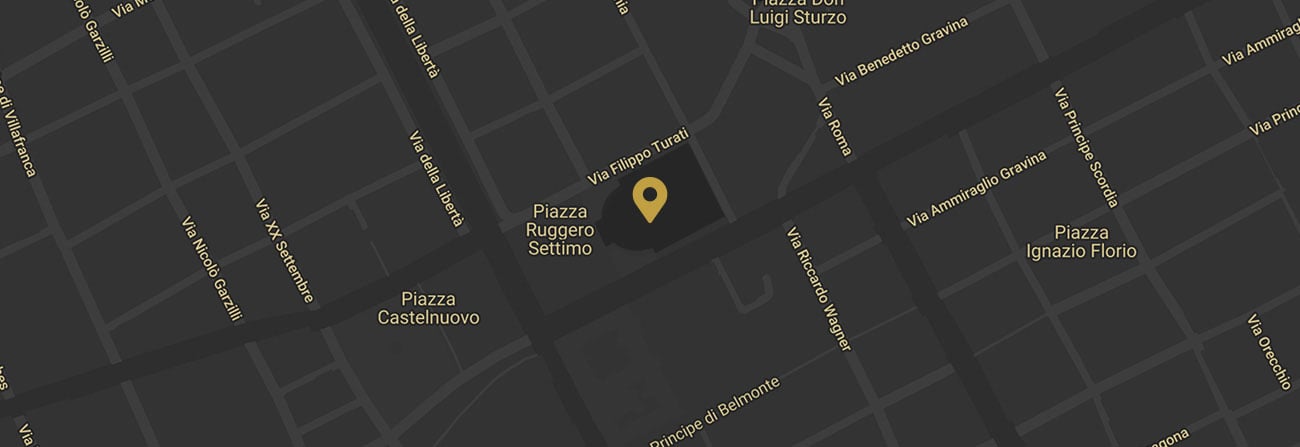
Today, the theatre is the prestigious home of the Orchestra Sinfonica Siciliana Foundation and is a reference point of great importance both for location and notariety for the City of Palermo. Often the two large squares facing one another (Ruggero Settimo and Castelnuovo) where the theatre is situated are commonly referred to as Piazza Politeama.

Giuseppe Damiani Almeyda

almeyda 100Born into a nobil Palermo family (he was the son of Felice Damiani and of Carolina Almeyda), Giuseppe Damiani Almeyda was born in Capua on February 10, 1834. Encouraged by his family to study arms, he demonstrated a great passion for design at a very young age and, thanks to his brother Francesco, began studying mathematics and design. Gustavo Mancinelli was one of his teachers. After studies in Naples at the School of Bridges and Roads, in 1859 he transferred to Sicily and in 1872 became the engineer for the City of Palermo, maintaining the position until 1891. Professor at the Technical Institute and at the University of Palermo, he won numerous prizes for architecture and wrote significant articles, treatises and monographs in which he joined his love for design and art history (for example The History of Modern Italian Art; Applications of Elementary Geometry to the Study of Design; Istituzioni Ornamentali sull'Antico e sul Vero).

His significant works are characteristic of the artistic and cultural life of his times connoting the history of Sicilian architecture at the end of the 1800's and the beginning of the 1900's. Tenacious opponent of Basile's modernism and of floral taste, he died in Palermo on January 13, 1911 leaving us architectural masterpieces such as the small buildings at Villa Giulia in Palermo, the Villa Florio in Favignana, the Grand Hotel of the Thermal Baths in Termini Imerese, the Oretea Foundry (today demolished) in Palermo and, above all, the beautiful Politeama Garibaldi where his love of color and polychromy triumph.